Talk to it
Try one of the prompts, or type your own.Next-letter guess
How a letter moves through it
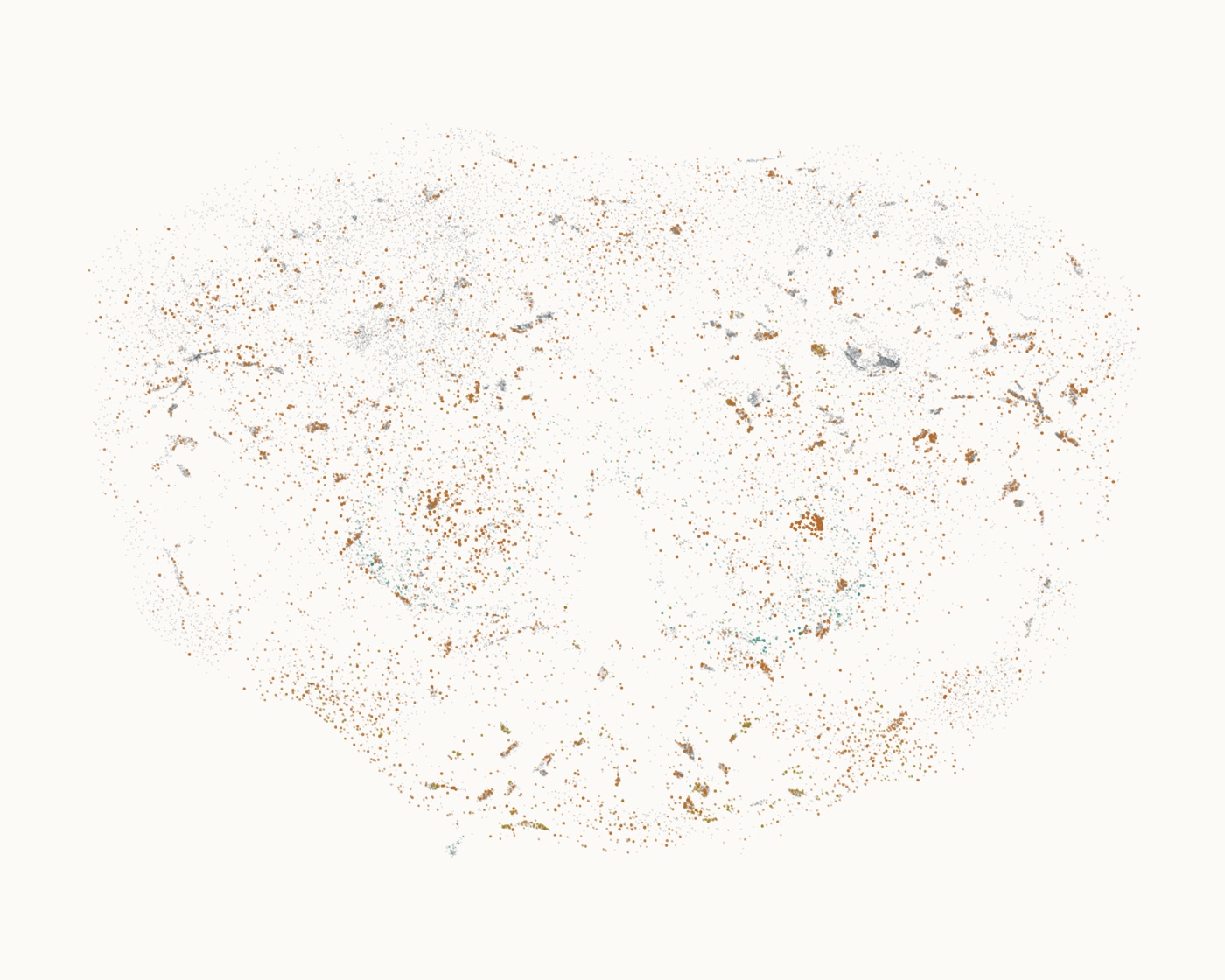
The fruit fly brain has been mapped one synapse at a time by the FlyWire project. Most neural networks use a wiring pattern someone designed. This one uses the fly's: every connection here exists in a real animal. Training can change synapse strength and how each neuron rests, leaks and tires, but it can't add or remove a connection.
Input as smell
Each character is assigned a fixed odour, a pattern across the fly's 106 olfactory glomeruli. Typing h activates the receptor neurons for that pattern.
Five ticks of spiking
The signal runs through the connectome for five time steps, enough to cross the three or four synapses between the antennae and the output.
Output
The 1,299 descending neurons, which a real fly uses to drive its legs and wings, are split into one group per character. The most active group is the next letter.
Memory
Nothing resets between letters. Earlier input stays in the network as voltage and fatigue, and that residue is the only short-term memory it has.
What it can do
The training data is short lines, mostly small problems where the answer depends on something earlier in the line. The test set includes words and rules that never appear in training.
| Task | Example | Letters correct | Answers correct | No-memory baseline |
|---|
Training history
Prediction error
Letters correct, by task
The same prompts at every checkpoint
Its own answers, recorded during training. Spaces are shown as ␣.
Limitations
- It isn't a fly and it isn't conscious. It uses a fly's wiring diagram as a computer. A real fly can't read.
- It is slow to train. Each character costs five time steps across 36,000 neurons and nearly a million connections, forward and backward, which is roughly 1,000 times slower than a conventional model of the same size.
- Only connections with five or more synapses are kept, FlyWire's usual confidence threshold. Signs follow Dale's law, so an excitatory neuron can't learn to inhibit.
- The comparison that matters is whether the real wiring learns better than the same neurons wired at random. I haven't run that control yet; it's next.