Dopamine
Daniel Johnson Quintero

Projects/September 2026

Fly Chess

Chess against the learning centre of a fruit fly's brain. It judges each move by how the resulting position smells, and a dopamine signal adjusts its synapses after every game, including yours.

Kenyon cells
5,177
Learning synapses
62,261
Input neurons
685
Elo
—
Loading the connectome…
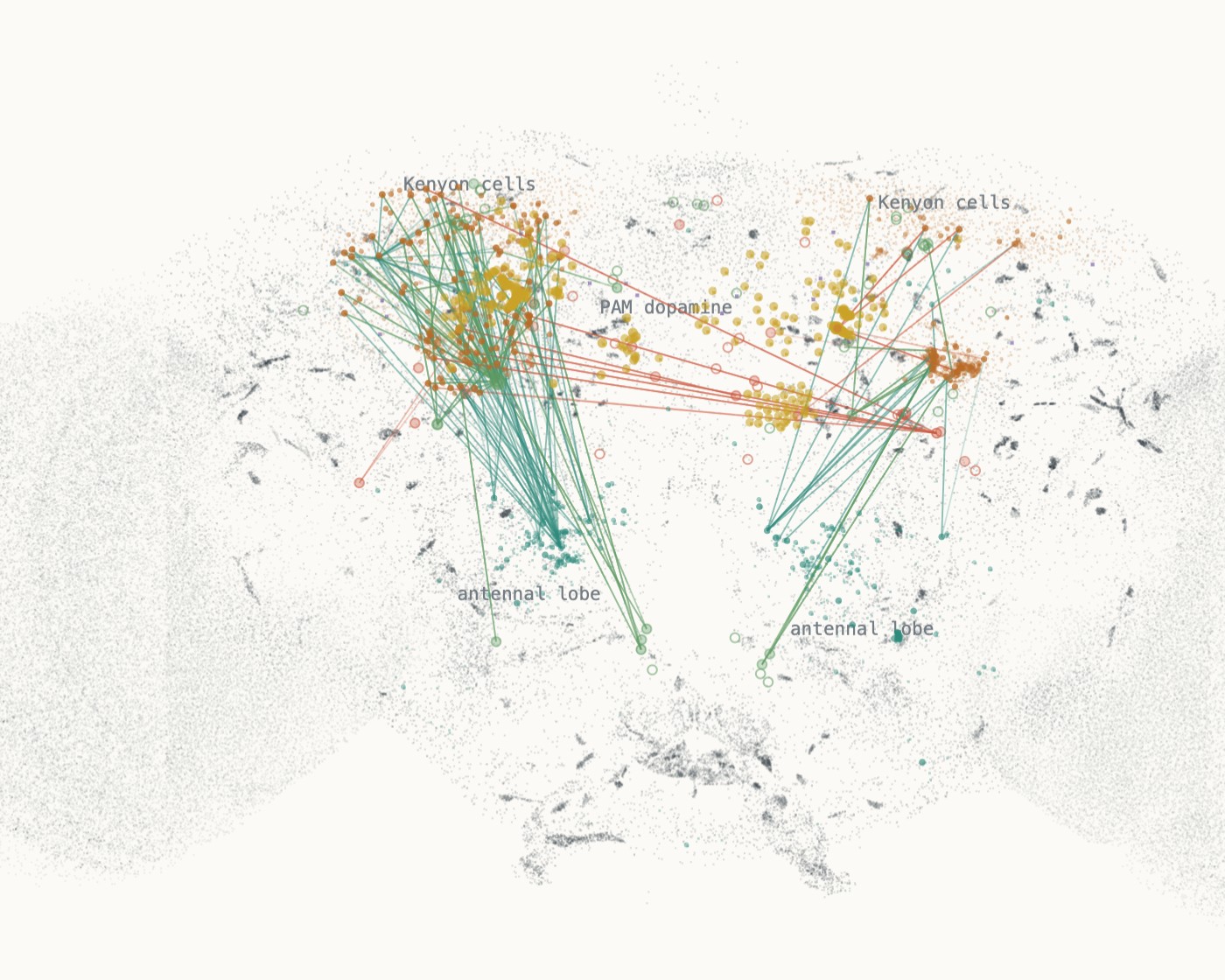
The fly's brain from FlyWire, mid-move: signals run from the antennal lobes (teal) up to the Kenyon cells (orange) and out to the output neurons voting for or against the move, while PAM dopamine neurons (gold) fire.
01

Play

Click a piece, then a square. It moves as soon as you do.
Promote to
—
Game score (PGN) for Lichess, chess.com or any reader
Fig. 1The fly's whole brain from the front: each dot is one of its 138,625 FlyWire neurons at its real position. As it smells a move, the signal runs along real synapses from the antennal lobe to the Kenyon cells to the output neurons, and dopamine neurons fire when the result is better or worse than it expected.
Projection neuron (input) Kenyon cell Approach output Avoid output PAM dopamine (better) PPL1 dopamine (worse)

Valence and dopamine

How good the position smells0.00
Dopamine (prediction error)0.00

Output neuron vote

Moves it considered

Waiting for the fly's turn…
02

How strong it is

Rating

—not measured yet
Games it has learned from0
Memory changed0.000%
You vs. the fly, this session0–0–0

Estimated Elo over time

No measurements yet. Press Measure its Elo or start training.
Fig. 2Measured against the same built-in opponents the trainer uses, so treat it as a ballpark figure.
03

Leaderboard

People who have beaten the fly.
Sign in to put your name here, then play a game.
04

How it chooses a move

Step 1

Encode

For every legal move, the position it leads to is written onto 685 antennal-lobe projection neurons, the cells that carry smell into the mushroom body. Like the fly's dedicated CO₂ and geosmin channels, danger gets its own: 96 of them fire when a piece is left where it can be taken.

Step 2

Sparsify

The calyx keeps only the strongest 259 of the 5,177 Kenyon cells active, so each position gets its own sparse code.

Step 3

Vote

The output neurons (MBONs) sum that code. Approach cells push for the move, avoidance cells push against it. It plays the best-scoring move.

Step 4

Learn

Dopamine, a reward prediction error, rewrites the Kenyon cell to output synapses during play: PAM neurons when a move turns out better than expected, PPL1 when worse. Winning or losing material is felt at once; a win produces a large burst.